


IIASA Science Parliament הרצאתו של פרופ' רון מילוא במסגרת סדרת
Prof. Milo was the first guest to talk at the IIASA Science Parliament Lecture Series in Laxenburg, Austria.
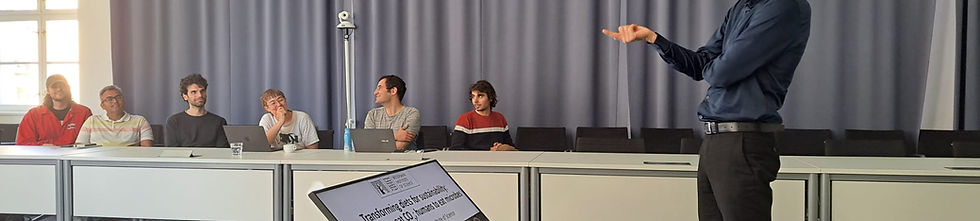
ביום שלישי, 21 במאי 2026, נשא פרופ' רון מילוא מהמחלקה למדעי הצמח והסביבה במכון ויצמן למדע הרצאה שכותרתה "Transforming Food Production for Sustainability: Microbes to Eat CO₂; Humans to Eat Microbes". ההרצאה הייתה אירוע הפתיחה של סדרת Science Parliament Lectures של IIASA בלקסנבורג, אוסטריה, ופרופ' מילוא היה המרצה האורח הראשון בסדרה.
תקציר ההרצאה:
Transforming food production is essential to help with food security, land and water stress, climatic and ecological stability etc. I will present our integrative analysis on the status of humanity’s impact on global wild biomass and proceed to describe how we evolved a microbe to change its diet from sugar to CO2. This is a milestone towards the vision of transforming CO2 into valuable products via microbial production, but can it become realistic economically? I will portray how we analyze the limitations and potential using a simplified techno-economic analysis. Going forward, I will discuss what can galvanize this essential innovative transformation by driving key catalytic elements: lower production prices, better taste and improved health outcomes.
אודות פרופ' רון מילוא:
Ron Milo earned a BSc in physics and mathematics and a PhD in biological physics before being a fellow at Harvard Medical School department of Systems Biology. He joined the Weizmann Institute in 2008. Prof. Milo harnesses the tools of systems biology to find solutions to the challenges of sustainability. His main contribution in this aspect was his demonstration of an ability to convert carbon dioxide into sugar in a synthetically-engineered E. coli. Prof. Milo also leads a global accounting of biomass on earth giving a fresh perspective on the impact of humanity and the future of biodiversity. Milo is the author of the book “Cell Biology by the Numbers” read online and in print by over 1 million people a year and translated to multiple languages. Prof. Milo enjoys playing the harmonica and hiking with his wife, Hilla, and their three daughters, Geffen, Yaara & Rimon.
On Tuesday, 21 May 2026 , prof. Ron Milo of the Department of Plant and Environmental Sciences at the Weizmann Institute for Science gave a talk on "Transforming food production for sustainability: microbes to eat CO2; humans to eat microbes". Prof. Milo was the first guest to talk at the IIASA Science Parliament Lecture Series in Laxenburg, Austria.
Abstract
Transforming food production is essential to help with food security, land and water stress, climatic and ecological stability etc. I will present our integrative analysis on the status of humanity’s impact on global wild biomass and proceed to describe how we evolved a microbe to change its diet from sugar to CO2. This is a milestone towards the vision of transforming CO2 into valuable products via microbial production, but can it become realistic economically? I will portray how we analyze the limitations and potential using a simplified techno-economic analysis. Going forward, I will discuss what can galvanize this essential innovative transformation by driving key catalytic elements: lower production prices, better taste and improved health outcomes.
About the speaker
Prof. Ron Milo earned a BSc in physics and mathematics and a PhD in biological physics before being a fellow at Harvard Medical School department of Systems Biology. He joined the Weizmann Institute in 2008. Prof. Milo harnesses the tools of systems biology to find solutions to the challenges of sustainability. His main contribution in this aspect was his demonstration of an ability to convert carbon dioxide into sugar in a synthetically-engineered E. coli. Prof. Milo also leads a global accounting of biomass on earth giving a fresh perspective on the impact of humanity and the future of biodiversity. Milo is the author of the book “Cell Biology by the Numbers” read online and in print by over 1 million people a year and translated to multiple languages. Prof. Milo enjoys playing the harmonica and hiking with his wife, Hilla, and their three daughters, Geffen, Yaara & Rimon